
Hindu Marriage Biodata: Gotra, Rashi, and Kundli Spacing Rules
Discover the essential elements of a Hindu marriage biodata format, including Gotra, Rashi, Nakshatra, and Kundli details, along with layout spacing rules.
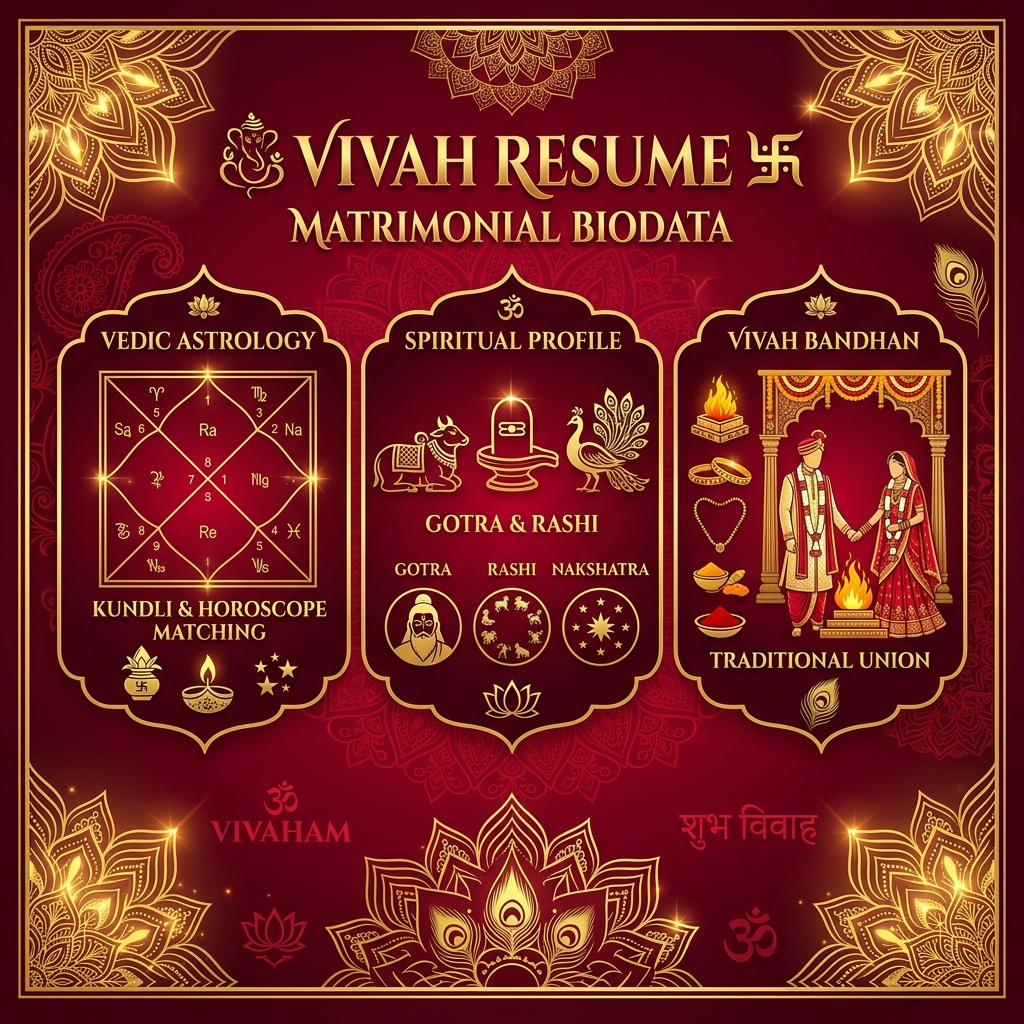
Creating a Hindu marriage biodata is a process steeped in both cultural tradition and modern formatting standards. For generations, Hindu families have relied on specific details to evaluate compatibility, character, and familial alignment. In the modern era, presenting this information clearly is just as important as the details themselves. A messy, poorly spaced document can overshadow even the most impressive profile.
This comprehensive guide explores the essential components of a Hindu marriage biodata format—including Gotra, Rashi, Nakshatra, and Kundli (horoscope matching details)—and outlines the spacing and design rules needed to create a visually appealing, highly readable document.
---
The Cultural Significance of Astrological Details
In Hindu matchmaking, astrology (Jyotisha) is often the very first filter. Before families discuss career, education, or personal hobbies, they look at the astrological compatibility. Stating these details accurately upfront saves time and prevents misunderstandings later.
### 1. Understanding Gotra
A person's Gotra refers to their paternal lineage, traced back to one of the ancient Hindu sages (Rishis). In Hindu culture, marrying someone of the same Gotra (Sagotra marriage) is traditionally avoided in many communities, as it is considered equivalent to marrying a sibling. Therefore, including your Gotra prominently on your biodata is crucial for families to determine if the alliance is culturally permissible.
### 2. Rashi and Nakshatra
Your Rashi (Moon Sign) and Nakshatra (Birth Star) are calculated based on the exact date, time, and place of your birth. These elements form the foundation of Kundli matching (Guna Milan), where 36 points (Gunas) are matched between the bride and groom. Providing these details allows the recipient's family to consult their priest or use online matching tools to check compatibility immediately.
### 3. Manglik Status (Mangal Dosha)
Manglik status is determined by the position of Mars in one's birth chart. If Mars is placed in specific houses, the person is considered a Manglik. This can be Purna Manglik (strong) or Anshik Manglik (partial/mild). Since Manglik individuals are traditionally advised to marry other Mangliks to balance the energies, stating your Manglik status clearly is a sign of honesty and respect.
---
How to Structure Your Hindu Marriage Biodata
To ensure that your profile is both complete and easy to navigate, group your information into logical, well-demarcated sections.
### Section 1: Basic Personal & Astrological Details
This section should be at the very top of your biodata, immediately following your name.
•**Full Name**: Set in bold, larger font.
•**Date of Birth**: Use a clear format (e.g., 15th October 1995).
•**Time of Birth**: Specify AM or PM and include the time zone if born outside India (e.g., 08:45 AM).
•**Place of Birth**: City and State (e.g., Pune, Maharashtra).
•**Height**: In feet and inches (e.g., 5'11").
•**Religion / Caste / Sub-Caste**: (e.g., Hindu / Brahmin / Saraswat).
•**Gotra**: (e.g., Bharadwaj).
•**Rashi & Nakshatra**: (e.g., Simha Rashi, Poorva Phalguni Nakshatra).
•**Manglik Status**: Specify clearly (e.g., Non-Manglik, Anshik Manglik, or Manglik).
### Section 2: Education and Career
Highlight your achievements and professional standing.
•**Highest Qualification**: (e.g., B.Tech in Computer Science from NIT Trichy).
•**Schooling & College**: Mention institutions if they are reputed.
•**Current Occupation**: Job title and company name (e.g., Senior Consultant at Deloitte).
•**Work Location**: City (e.g., Mumbai).
•**Annual Income**: Optional, but helpful (e.g., ₹15 LPA+).
### Section 3: Family Background
In Hindu culture, marriages are alliances between two families. This section must reflect respectability and transparency.
•**Father's Name & Occupation**: (e.g., Mr. Ramesh Joshi, Retired Government Officer).
•**Mother's Name & Occupation**: (e.g., Mrs. Kalpana Joshi, Homemaker / Former Teacher).
•**Siblings**: Mention names, qualifications, and marital status (e.g., 1 Elder Sister, Married, MBA working in HR).
•**Family Values**: Specify if the family is traditional, moderate, or liberal.
---
Layout and Spacing Rules for a Premium Design
A beautiful biodata is defined by its typography and whitespace. If your document is cluttered, readers will struggle to find key information. Follow these design and spacing rules:
### 1. Consistent Margin and Padding
Ensure a minimum margin of 0.75 inches (approx. 20mm) on all sides of the page. This prevents text from getting cut off during printing or when opened on mobile screens. If you are using a border, keep the text at least 15px away from the border line.
### 2. Line Spacing and Paragraph Breaks
Set your line spacing (line-height) to 1.4 or 1.5 for body text. For bullet points and list items, use a spacing of 8px to 10px between items. Avoid placing multiple details on a single line; each field (like Gotra or Rashi) deserves its own line to breathe.
### 3. Clear Typography Hierarchy
•**Title (Your Name)**: 24px to 28px, Bold.
•**Section Headings**: 16px to 18px, Bold, Uppercase or Title Case.
•**Field Labels (e.g., Gotra:)**: 12px to 14px, Bold.
•**Field Values**: 12px to 14px, Regular.
•Use clean fonts like **Inter**, **Outfit**, or **Roboto**. Avoid overly decorative script fonts which are hard to read.
### 4. Color Palette
Stick to rich, culturally symbolic colors. Gold accents paired with deep crimson, maroon, or royal blue are excellent for a Hindu biodata. Use pastels or cream backgrounds to ensure high contrast with the text.
---
Sample Hindu Matrimonial Biodata Copy
Below is a structured text example representing a complete, well-spaced Hindu profile:
Shri Ganeshay Namah
Personal Information
•**Name**: Aditya Kulkarni
•**DOB**: 24th December 1994 | **Time**: 11:15 AM
•**Place**: Nashik, Maharashtra
•**Height**: 5'10"
•**Caste**: Hindu / Maratha
•**Gotra**: Kadam
•**Rashi / Nakshatra**: Dhanu / Mula
•**Manglik**: Non-Manglik
Education & Profession
•**Education**: Master of Science (MS) in Data Science, BITS Pilani (2018)
•**Profession**: Senior Data Analyst at TCS, Pune
•**Income**: ₹18 LPA
Family Background
•**Father**: Mr. Vinayak Kulkarni (Retired Principal)
•**Mother**: Mrs. Sunita Kulkarni (Homemaker)
•**Brothers**: 1 Younger Brother (Currently pursuing B.E.)
•**Sisters**: None
•**Native Place**: Karad, Satara
---
By adhering to these structure and design guidelines, you respect traditional values while presenting yourself as a modern, organized professional. This balance is key to catching the eye of compatible matches.
Common Questions
Why is Gotra important in a Hindu biodata?
Gotra identifies one's ancestral lineage. In many Hindu communities, marrying within the same Gotra is avoided to prevent genetic similarities.
Should I include my complete horoscope chart?
No, a complete chart is not necessary. Including birth date, time, place, Gotra, Rashi, and Nakshatra is sufficient for initial compatibility checks.
What does Manglik status mean?
Manglik refers to the presence of Mangal Dosha in one's birth chart, indicating Mars' strong influence. Knowing this helps families match profiles with similar astrological traits.
Create your perfect biodata now
Join thousands of families who have successfully created their matrimonial profiles with RishtaMaker.