
Crafting the Perfect Muslim Matrimonial Biodata for Nikah
A detailed guide on formatting a Muslim matrimonial biodata for Nikah, balancing professional achievements with Islamic religious values.
Marriage (Nikah) is a sacred sunnah and a central pillar of life in Islam. When embarking on the journey to find a compatible life partner, a Muslim matrimonial biodata serves as your introduction to potential matches and their families. Writing a biodata that balances professional achievements, family roots, and Islamic values requires a thoughtful approach.
Unlike a standard corporate CV, a matrimonial biodata needs to convey your character (Akhlaq), your religious outlook, and your vision for a shared, faith-centered future. This comprehensive guide outlines how to structure a Muslim marriage biodata, what religious details to include, and how to articulate partner expectations in a respectful manner.
---
Crucial Sections in a Muslim Matrimonial Biodata
To ensure your biodata is well-structured and covers all essential elements, divide your information into the following categories:
### 1. Basic Personal Details
Start with your basic details, which provide a snapshot of your physical presence and identity.
•**Full Name**: (e.g., Zeeshan Ahmed).
•**Date of Birth**: Use a clear format (e.g., 5th May 1996).
•**Height**: (e.g., 5'9").
•**Complexion / Appearance**: (Optional, e.g., Fair, Wheatish).
•**Marital Status**: (e.g., Single, Divorced, Widowed).
### 2. Religious Background (Deen)
In Islamic matchmaking, compatibility in religious practices and beliefs (Maslak) is highly valued. Including this section ensures that you align with families sharing similar values.
•**Sect / Maslak**: Mentioning your sect (e.g., Sunni / Hanafi, Sunni / Shafi, or Shia) helps match with families who follow the same school of thought.
•**Religious Practices**: Briefly describe your daily practices (e.g., Perform Namaz 5 times daily, Fasting during Ramadan, Hajj/Umrah performed).
•**Hijab / Abaya Preference**: For brides, mentioning if you observe Hijab or Abaya, and for grooms, stating your expectations regarding modesty helps set clear boundaries.
•**Dietary Habits**: State if you strictly follow Halal dietary choices (especially relevant for those living in Western or multicultural countries).
### 3. Professional and Academic Profile (Dunya)
Highlighting your intellectual pursuits and career achievements shows responsibility and direction.
•**Education**: Mention your highest degree and institution (e.g., MBA in Finance, Jamia Millia Islamia).
•**Occupation**: (e.g., Senior Software Developer at Microsoft).
•**Work Location**: (e.g., Hyderabad, India).
•**Financial Stability**: Mentioning your income is optional but often appreciated, especially for grooms who bear the traditional financial responsibilities.
### 4. Family Information
Family reputation and background are integral to Muslim marriages. Detail your family members and their roles.
•**Father's Name & Occupation**: (e.g., Mohammad Farooq, Businessman - Real Estate).
•**Mother's Name & Occupation**: (e.g., Yasmin Farooq, Homemaker).
•**Siblings**: (e.g., 2 Elder Brothers - Both married and settled in Dubai; 1 Younger Sister - Pursuing MBBS).
•**Family Status**: Mention if you belong to a religious, moderate, or modern family background.
---
Formulating Partner Expectations for Nikah
Articulating what you seek in a spouse is the most critical part of the biodata. It should be written in a positive, respectful tone that reflects Islamic values of humility and clarity.
### Examples of Partner Expectations for Grooms:
> "I am looking for a pious, educated, and family-loving partner who performs her daily prayers and values Islamic principles. A working professional or homemaker who is willing to support each other in deen and dunya would be an ideal match."
### Examples of Partner Expectations for Brides:
> "I seek a well-educated, responsible, and caring partner who is grounded in Islamic values and earns a halal livelihood. Someone who possesses good character (Akhlaq), respects elders, and is supportive of my professional aspirations is what I hope for."
---
Design and Aesthetic Guidelines
To create a visually appealing, premium biodata, follow these design practices:
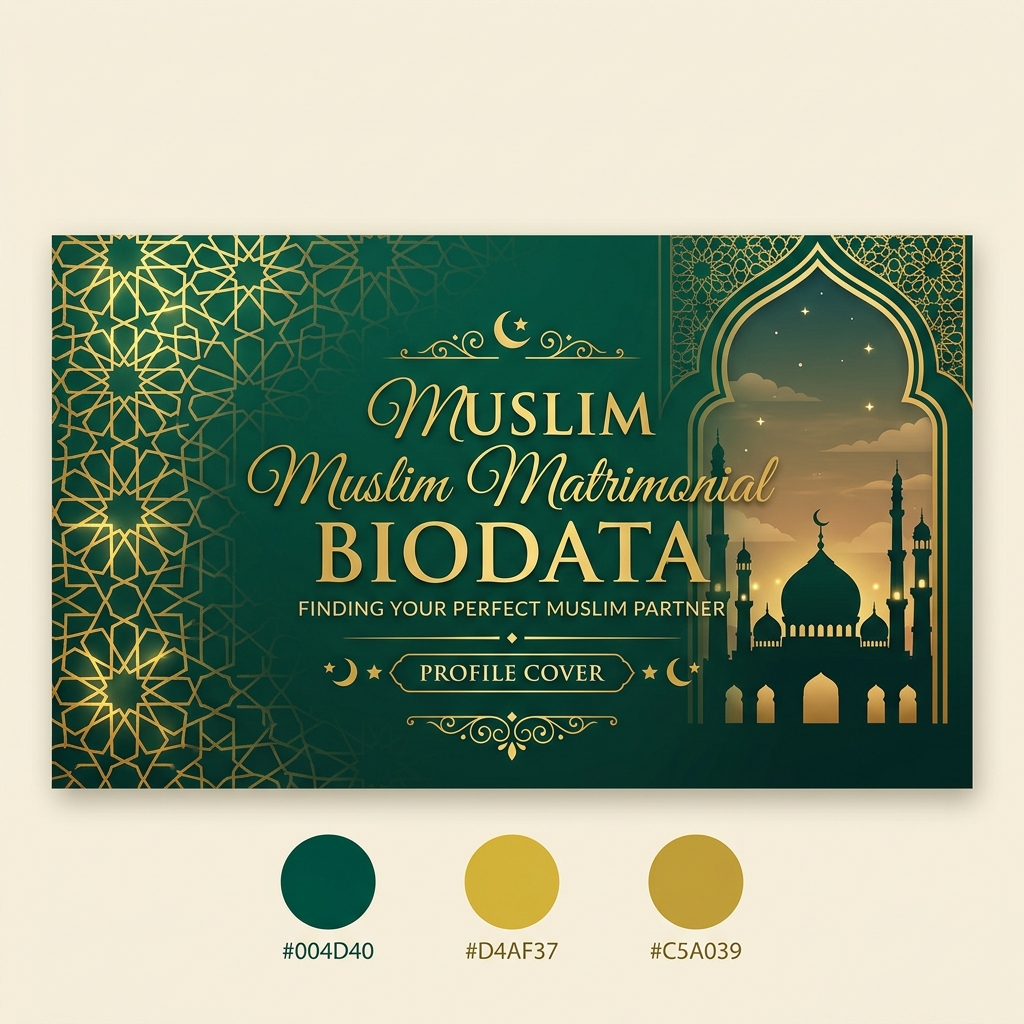
•**Color Scheme**: Choose elegant, respectful colors. Emerald green, deep olive, soft gold, and classic beige work beautifully for a Muslim biodata as they carry cultural and religious significance.
•**Aesthetic Accents**: Subtle Islamic geometric patterns or minimalist borders can frame your text elegantly. Avoid busy backgrounds that distract from the readability of the text.
•**Clear Typography**: Use legible sans-serif fonts such as Inter, Outfit, or Helvetica with a line height of **1.5** to make reading comfortable for elders.
---
Sample Muslim Matrimonial Copy
Bismillah-ir-Rahman-ir-Rahim
Personal & Religious Details
•**Name**: Sarah Khan
•**DOB**: 12th September 1997
•**Height**: 5'4"
•**Sect / Maslak**: Sunni / Hanafi
•**Religious Outlook**: Perform Namaz regularly, observe Hijab, and value Islamic traditions.
Education & Career
•**Education**: Bachelor of Dental Surgery (BDS), Aligarh Muslim University (2020)
•**Profession**: Consultant Dentist at Prime Dental Care, Delhi
•**Languages**: English, Hindi, Urdu
Family Details
•**Father**: Dr. Tariq Khan (Retired Medical Officer)
•**Mother**: Mrs. Nilofer Khan (Homemaker)
•**Siblings**: 1 Brother (Software Engineer in Canada), 1 Sister (Married, settled in Lucknow)
•**Resident Location**: Okhla, New Delhi
---
By presenting your deen and dunya details truthfully and beautifully, you invite compatible families to reach out with respect and shared purpose.
Common Questions
Should I mention my Maslak/Sect on the biodata?
Yes, it is highly recommended as different sub-sects have distinct religious practices, and clarity upfront avoids compatibility issues.
How should I describe my religious values?
Be honest. Mention your daily prayer habits, whether you observe Hijab/Abaya, and your commitment to Halal practices in a simple, respectful statement.
Is it appropriate to request a photograph?
Yes, in modern matchmaking, exchanging photographs is standard, but you can request that it be kept confidential between the parents.
Create your perfect biodata now
Join thousands of families who have successfully created their matrimonial profiles with RishtaMaker.